Catching the intersection of retention signals before the student leaves
A research brief on why students slip through the gaps between departments
Buffalo, NY
Research Brief
By Mary Ruelle, Director of Higher Education and Workforce Development at WellConnected
Maria is a composite drawn from patterns across multiple institutions, not a real individual.
In August, Maria's file looked fine: fifteen credits, a signed advising plan, and no flags. By December, she had withdrawn.
Three offices each saw a piece of what was happening to her. None of them saw the whole. That is the gap this brief is about, and it costs more than most institutions realize: the signs a student is leaving rarely sit in one place, so the schools that catch students in time are the ones set up to see all the signs at once.
I. The Problem We Only See in Hindsight
When a student like Maria withdraws, the institution can usually explain why, afterward. The transcript shows the GPA slide. The advising notes show the missed appointments. A referral sits unanswered in someone's inbox. Each office held a piece of it, and once she's gone, those pieces can be put together into a story.
But that story is an autopsy. It doesn't tell you in time to do anything about it.
The reason is structural. Academic success, student engagement, and basic needs are studied, staffed, and funded as separate areas, and most institutions organize their response the same way. So, a struggling student rarely shows up as one clear signal; she shows up as a partial signal in all three at once, where no one is set up to see them together.
The clearest signal that a student is in trouble lives in the overlap between these three areas, and the institutions that catch students earlier are the ones learning to read that overlap as a single picture instead of three separate caseloads. It's drawn from practice and from the research that follows.
There's a reason this gap shows up almost everywhere: no one owns it. Advising answers to one office, engagement to another, basic needs to a third. That missing vantage point is what keeps turning prevention into hindsight. It has little to do with how hard anyone is working.
II. Three Streams, One Student
Academic success: classes, advising, tutoring, and the guidance that keeps a student on a real path to a credential. How often a student sees an advisor, and how good those conversations are, is one of the most studied predictors of whether they stay. For Maria, this was the advisor who approved her schedule in August, logged her missed check-ins in October, and sent a few emails that went unanswered, with no clear next step once she stopped coming to class.
Student engagement: whether a student feels connected enough to the place, its people, and its community to want to stay. It's what surveys like CCSSE and its four-year counterpart, NSSE, are built to measure, and when that connection starts to fray, someone usually notices. For Maria, it was the resident advisor who watched her stop coming to floor events and wanted to help, but had nowhere to send what she'd seen.
Basic needs: food, housing, transportation, childcare, technology, all the things a student has to have in place before coursework is even possible. It's the newest of the three to be studied closely, and it turns out to be far more common than most institutions assumed. For Maria, this was a single email to a community food pantry, sent by a financial aid counselor who cared enough to make the referral and then never heard whether it reached her, whether she went, or whether it helped. The referral left the building and vanished.
Each of these has its own research, its own tools, its own owner. That works well for studying the problem. It’s difficult for the student living all three at once.
III. The Intersection: Where the Real Signals Live
By October, Maria's GPA had slipped from a 3.1 to a 2.4, she'd missed two advising check-ins, and stopped attending residence hall programming. Academic success saw a student falling behind. Student engagement saw a student pulling away. Basic needs, if anyone there had known, would have seen a student picking up extra shifts to make rent. Same student, same weeks, three partial readings, and no shared place to lay them side by side and see the whole of what she needed.
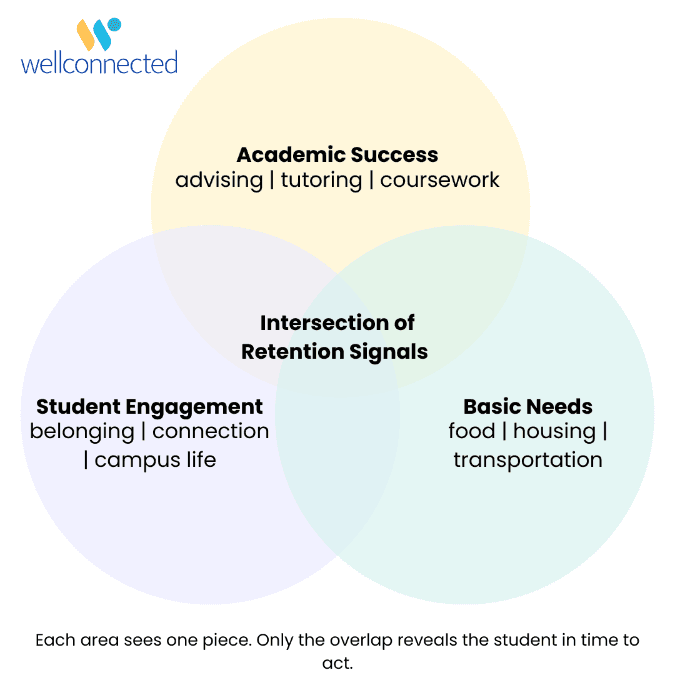
This blind spot has three layers and the gap surfaces in the research on each stream.:
Within one student. The signals sit in separate offices and never combine.
Across many students. Patterns no single office can see.
Beyond campus. Referrals to off-campus help that never close the loop.
Within one student
Nationally, about two-thirds of community college students are navigating some form of food or housing insecurity, yet fewer than half engage with the campus supports meant to help (RP Group, 2025; Hope Center, 2024), and the students least able to make it to an advising appointment are often the same ones carrying that load. Advising is one of the most reliable levers there is: first-year students retain at rates three to six percentage points higher after even one substantive advising contact (EAB, n.d.). Read separately, these findings are different arguments for different budgets. Read together, they describe a single student with needs no one office is positioned to see.
Across many students
A whole cohort might keep seeking help with the same course. Third-year students might stop showing up in career services referrals. First-year students from a single feeder school might all be seeking tutoring. Most of the wins might trace back to one office while another rarely refers anyone. That's exactly what an institution needs to know to spend its next dollar well, and almost no one can see it today, because the referral information lives in separate systems and inboxes that were never built to talk to each other. The point is to finally see the pattern no single office can see on its own, so resources are allocated where it does the most good, for students and for the institution.
Beyond campus
No school staffs every need. A college might not have its own food pantry, enough counselors to meet the demand, or any housing help for a student facing eviction, so the referral goes out to a food bank, a county clinic, a housing authority. The moment it leaves, most institutions lose the thread entirely, exactly the way they did with Maria's pantry email.
It's worth being honest about why. Following a student's need across separate agencies, and knowing whether it was ever met, means sharing information between organizations that each answer to their own privacy rules, FERPA on one side, HIPAA or agency policy on the other. Doing that safely, securely, and lawfully is genuinely hard, and that difficulty is why most institutions have quietly lived with the blind spot for so long. A full picture of retention depends on closing this gap, because the students at highest risk are so often the ones whose needs reach beyond what any single campus can provide.
What Maria's Withdrawal Costs the Institution
Set the story aside for a second and do the math for your own campus. Fill in your own numbers:
A. Net tuition revenue per student, per semester ........ $ ______
B. Semesters left until this student graduates .......... $ ______
C. Lost tuition if she leaves now (A × B) ............... $ ______
D. Cost to recruit one replacement student .............. $ ______
E. Total cost of one preventable withdrawal (C + D) ..... $ ______
For a rough sense of scale: at $9,000 a semester with five semesters to go, one withdrawal is $45,000 in lost tuition. Add a conservative $3,000 to recruit a replacement, and a single preventable exit runs about $48,000. Multiply that by the students you lose each year to problems earlier visibility might have caught, and you're into the millions. It's the same math your board already works with, pointed at a problem most institutions can't yet see coming.
IV. What This Means for Your Seat at the Table
If you own net tuition revenue. Every student who slips away before anyone connects the three signals is revenue you could have kept, and the worksheet above shows the size of it. At a tuition-dependent private college, where a single melted deposit or a week-three no-show can move the budget, that math is concrete. It's the difference between making the class and missing it.
If you own program viability and accreditation. A missing view of how support is used across the institution, and whether it works, is itself an evidence problem, one that surfaces the next time a board or accreditor asks what was done before a student left. It's also a planning problem: when the information is scattered, resource decisions get made on partial data, when the full picture is sitting right there in the evidence, waiting to be assembled.
If you own service delivery. Your team is probably already seeing pieces of this, the way Maria's resident advisor did, in referrals made and never confirmed, in coordinators keeping track by spreadsheet and personal email, with no reliable way to know whether the other two areas are looking at the same student at the same time.
These aren't three problems. They're one problem, seen from three chairs.
See for Yourself: A Quick Self-Check
Take two minutes and see how many you can already answer yes to on your own campus:
You can pull a single student's full support history, across academic, engagement, and basic needs, in one place, without emailing three offices to assemble it.
You get flagged while it's happening when several offices are all working with the same student, not weeks later when you go looking.
You can see which programs or student populations are quietly losing people, not just which individuals are struggling.
You can see which kinds of support are actually helping students stay, so you can put more behind what works and less behind what doesn't.
When a student is referred off campus, to food, housing, or mental health support, someone finds out whether the student connected and whether it helped them stay.
Most institutions can only say yes to one or two of these, not for lack of trying, but because no one's had the tools to see the whole picture at once. That's the gap this brief has been describing, and it's one you can close.
V. A Head of Retention: The Function No One Owns
If those questions are hard to answer yes to, that's the point: no one office was ever meant to answer them alone. Most campuses have many offices that touch retention, and none of them owns the whole view, because the role that would has never existed.
Picture Maria's semester one more time, with a single thing changed. The advisor's logged concern, the resident advisor's worry, and the pantry referral that went unanswered all show up in one place, where someone can finally see them together. In October, that someone recognizes the same three signals we did, a student falling behind, pulling away, and quietly picking up extra shifts to make rent, and sees one student in trouble rather than three separate notes in three separate systems. That is a student the institution can still reach with an informed, integrated approach.
That is what a head of retention does. Not one more person hired into a single department, but a function that can see academic, engagement, and basic needs signals together, on campus and beyond it, student by student and pattern by pattern. Every institution serious about retention needs it and almost none have it.
That function has been out of reach because its hardest part, following a student's need beyond campus and back, safely and lawfully, has never had a home. wellconnected was built to be that home. In practice, it means a coordinator can open one screen and see every place a student has been referred, across advising, student affairs, basic needs, and the community partners off campus, along with whether each referral was actually met. It does this in compliance with FERPA and applicable privacy law, with each partner controlling exactly what it shares, and it closes the gap this brief has been circling, the one that opens the moment a student's need leaves campus and that almost nothing else on the market safely can.
That's the difference between piecing the story together after a student is gone and seeing it while there's still a semester left to change how it ends.
Mary Ruelle spent 12 years in higher education before joining Well Connected Inc., working across academic advising, student conduct, career counseling, alumni relations, and experiential learning. She now works with institutions on connecting retention efforts across departments.
Mary Ruelle · mary@getwellconnected.co · linkedin.com/in/mary-ruelle
References
Center for Community College Student Engagement. (2018). Proactive advising leads to retention and graduation gains for colleges. Reported in Inside Higher Ed.
EAB. (n.d.). Who could benefit the most from more academic advising? EAB.
Hope Center for Student Basic Needs, Temple University. (2024). Student basic needs survey (2023–24 cycle). Temple University.
National Student Clearinghouse Research Center. (2025). Persistence and retention report: Fall 2024 entering cohort. National Student Clearinghouse.
The RP Group. (n.d.). Student support (re)defined. The Research and Planning Group for California Community Colleges.
The RP Group & Community College League of California. (2025). 2025 Real College California basic needs survey. The Research and Planning Group for California Community Colleges.
About us
WellConnected was formed in 2021 as a mission-driven startup aiming to create a better social safety net for the people in our society who need help.
Through its Allco software, the company brings a networked enterprise platform to a fractious and inefficient industry, driving collaboration between nonprofits and their funders. wellconnected has expanded into the states of New York, New Jersey, West Virginia and Illinois, where government entities and foundations are driving adoption to thousands of nonprofits
Those interested in learning more can reach out to wellconnected CEO Duane Conners at duane@getwellconnected.co.